
Mental Health & Student Wellness Policy
The following measures have been undertaken by the Institute to strengthen institutional measures for mental health support and student wellbeing:
1. Uniform Institutional Mental Health Policy: A comprehensive Mental Health & Student Wellness Policy has been formulated based on UMMEED Guidelines, Mano Darpan Framework, and National Suicide Prevention Strategy. The policy has been approved and is published on the Institute website and displayed on the notice boards as well. Provision has been made for mandatory annual review and update of the policy.
2. Appointment of Mental Health Professionals: The Institute has established a Mental health committee which includes one full-time Counsellors, one senior Psychiatrist and faculty members. Further, the Institute has a Medical Room Facility with one Psychiatrist who is available on 2nd & 4th Monday every month besides that on call of the institute as per the requirement and a Staff Nurse
3. Prohibition of Academic Practices Harmful to Students: The Institute avoids batch segregation based on performance, public shaming, disproportionate academic targets, or practices causing mental distress.
4.1 Referral to Mental Health Services: Mental Health Committee assesses urgency, severity, and nature of support prior to referral to ensure timely, appropriate, and ethical care. A clear referral pathway for both; internal and external referral has been established. Teaching and non-teaching staff have been trained to assist the students in ensuring safety and escort them for appropriate care. All referrals are required to be documented systematically, including assessments, consent, follow-ups. Confidentiality is maintained as per ethical and legal standards.
4.2 Local Hospitals -The institute has compiled and maintains a comprehensive list of nearby government and private hospitals for emergency medical and mental health referrals. The list of identified nearby hospitals is provided below for reference:
S. No Hospital name Contact Person
1. Maharaja Agrasen Hospital Jain Muni guru Ramkrishna Marg, Shivaji Park Block C
West Punjabi bagh
New Delhi-110026
Mob: 01140777777
2. Max Hospital Max Super Specialty Hospital, Shalimar bagh
FC 50, Max Road & D Block, Shalimar place site
New Delhi-110088
Mob: 01166422222
3 Braham shakti Hospital Pocket C, Budh Vihar phase I,
New Delhi- 110085
Mob: 08168361360
The Institute has established a tie up with BRAHM SHAKTI hospital to take care of medical emergency of students & staff members. Vehicle Services: The Institute also provides 24 x 7 Vehicle to take care of any medical emergency.
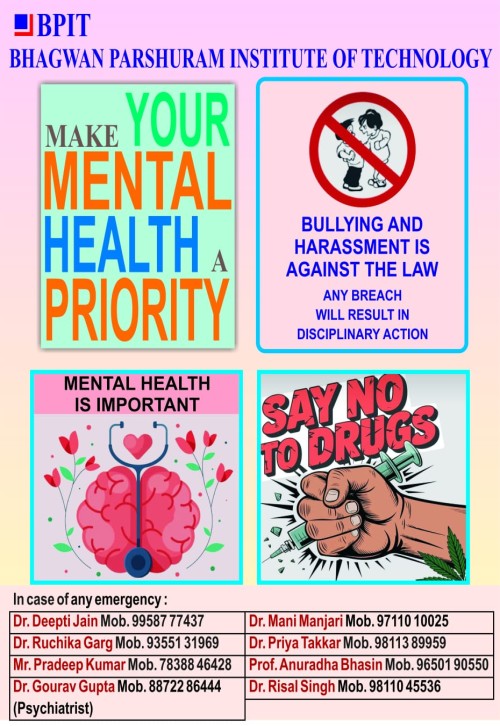
4.3 Suicide prevention helplines – The following suicide prevention helplines are displayed in Classrooms, Hostel, Common areas and Institute website. Students are encouraged to reach out to these functional helplines in case of emergency:
Tele-MANAS (National Mental Health Helpline)
● Toll-free: 1800-89-14416 | Short code: 14416
● Website: telemanas.mohfw.gov.in
● 24/7 national mental health support
AASRA – Suicide Prevention Helpline
● Phone: +91-9820466726
● Languages: English, Hindi
● Availability: 24/7
● Website: www.aasra.info
NIMHANS, Bengaluru – Helpline
● Phone: 080-46110007
● Website: nimhans.ac.in/pssmhs-helpline
KIRAN – National Helpline by Ministry of Social Justice
● Phone: 1800-599-0019
● 24/7 national support
I Call – Tata Institute of Social Sciences
● Phone: 022-25521111
● Email: icall@tiss.edu
Samaritans Mumbai
• Phone: +91 84229 84528 / +91 84229 84529 / +91 84229 84530
● Email: talk2samaritans@gmail.com
Sneha Foundation, Chennai – Suicide Prevention
● Phone: +91 44 2464 0050 / +91 44 2464 0060
● Email: help@snehaindia.org
Manas Foundation
● Website: manas.org.in
● Contact: 1800-89-14416
5. Mandatory Crisis Response and Safety Protocols: The Institute has developed written protocols (SOPs Under process) to ensure structured and prompt response during mental health emergencies. It has also been updated on the Institute’s website to ensure uniformity and timely care.
6. Mandatory Staff Training
Training programs are conducted regularly for academic and administrative staff to enhance mental health literacy, enable early identification of student distress, strengthen supportive communication skills, clarify crisis response boundaries, and familiarize staff with referral procedures. These sessions are delivered through workshops, orientations, and seminars, and participation records will be formally maintained for evaluation and feedback purposes.
Targeted groups –
1. Academic Staff
2. Non- Teaching and Admin Staff
3. Hostel Wardens
4. Hostel Staff
Action In Process-
● Workshop 27 April 2026
● Targeted Group- Academic staff, non-teaching staff
“Every Interaction Matters”: Supporting Student Well-being – This workshop will be based on the themes of Mental Health Awareness and Psychological First Aid.
7. Support for Vulnerable & Marginalized Students: The Institute ensures sensitive engagement with SC/ST/OBC, EWS, LGBTQ+, students with disabilities, trauma affected students, and those facing intersectional vulnerabilities.
Student Orientation Program is organized annually for all batches to familiarize the students and create awareness about the following:
● To orient students about the counselling cell and its services
● To Create awareness about the Mental Health Policy of the Institute
● To familiarize them about Student’s support services and available resources
● To inform students about the ways to access the Mental Health support
● To reduce stigma in seeking mental health support.
8. Robust Anti-Harassment & Anti Ragging Mechanisms
The Institute has the following committees:
• Internal Complaint Committee (ICC) (to ensure immediate action on cases of sexual harassment)
• Student Grievance Redressal Committee: To address the grievance of students.
• Anti-Ragging Committee: To ensure compliance with UGC Regulations on anti-ragging.
• Anti-Drug Committee: To ensure drug-free campus and provide healthy environment for students.
9. Parent and Student Sensitization
Programs are conducted by the professionals to educate parents about:
Avoiding academic pressure
Recognizing signs of distress
Providing Emotional Support
Virtual awareness and sensitization programs will be designed by Mental health Committee.
10. Mental health and wellness report:
Training and Intervention Records: Bi-annual records of all interventions conducted shall be documented. Details such as type of intervention, objective, frequency, target group, date, and duration shall be preserved for stakeholder review and feedback.
Referral System: A separate referral record for students and staff referred will be maintained with details including; Name, Reason for referral, Consent, Date and Referred Professional to trace the effectiveness of the assistance provided.
Record Keeping and Confidentiality: Counseling records along with consent form will be maintained with utmost confidentiality. Access to records will be restricted to authorized personnel only (Director’s, Principal and Committee members) as per institutional policy.
11. Campus and Hostel Safety Measures: The Institute ensures a harassment-free environment and also has an Anti-Drug Committee which is engaged in conducting activities to promote prevention of addiction amongst the students and ensure drug-free campus.
Facilities for Persons with Disabilities: The Institute follows a strict adherence for providing the entire milieu to be equal for all, which includes the infrastructure and facilities to be friendly, accessible, and sensitized towards individuals with any disabilities or special needs.
The Institute is fully accessible, with ramps and elevators provided in all the buildings. One manual wheelchair has been made available in the Institute for their comfortable mobility and access to the campus.
Tactile pathways have been installed across the entire campus for safe and easy travel to and from different parts of the Institute.
Conclusion:
The Institute is taking comprehensive and structured initiatives to institutionalize mental health and student wellbeing practices. The implemented policies, counseling services, crisis response protocols, training programs, and documentation systems ensure a safe, inclusive, and supportive campus environment for students and staff.
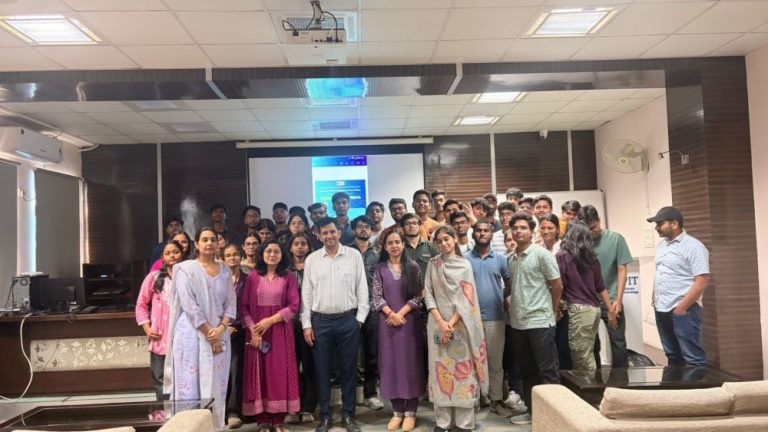
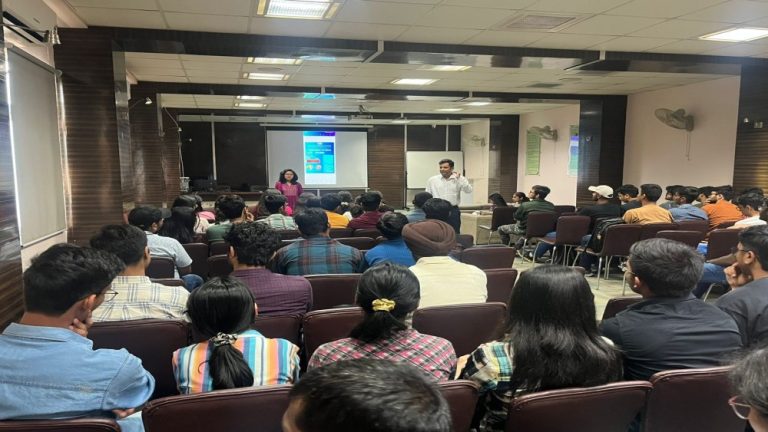
Photo Gallery's